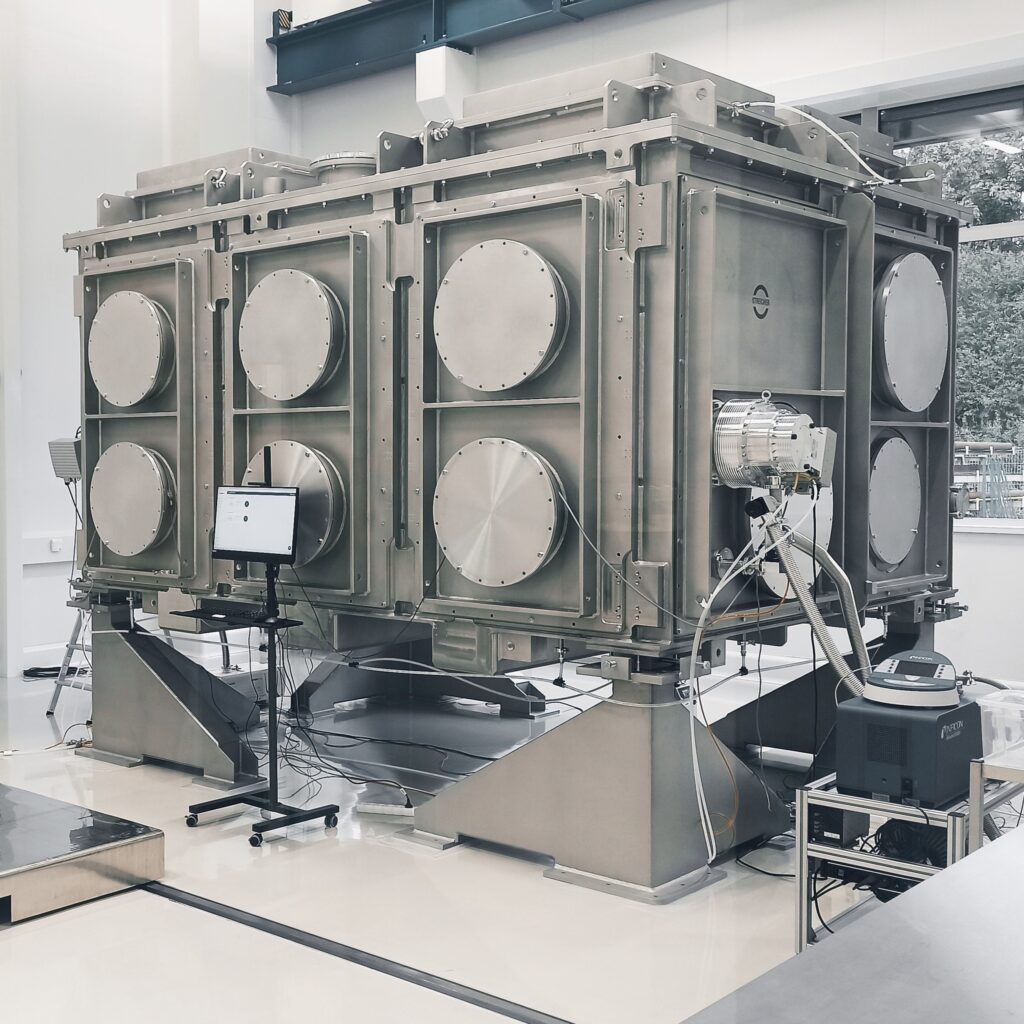
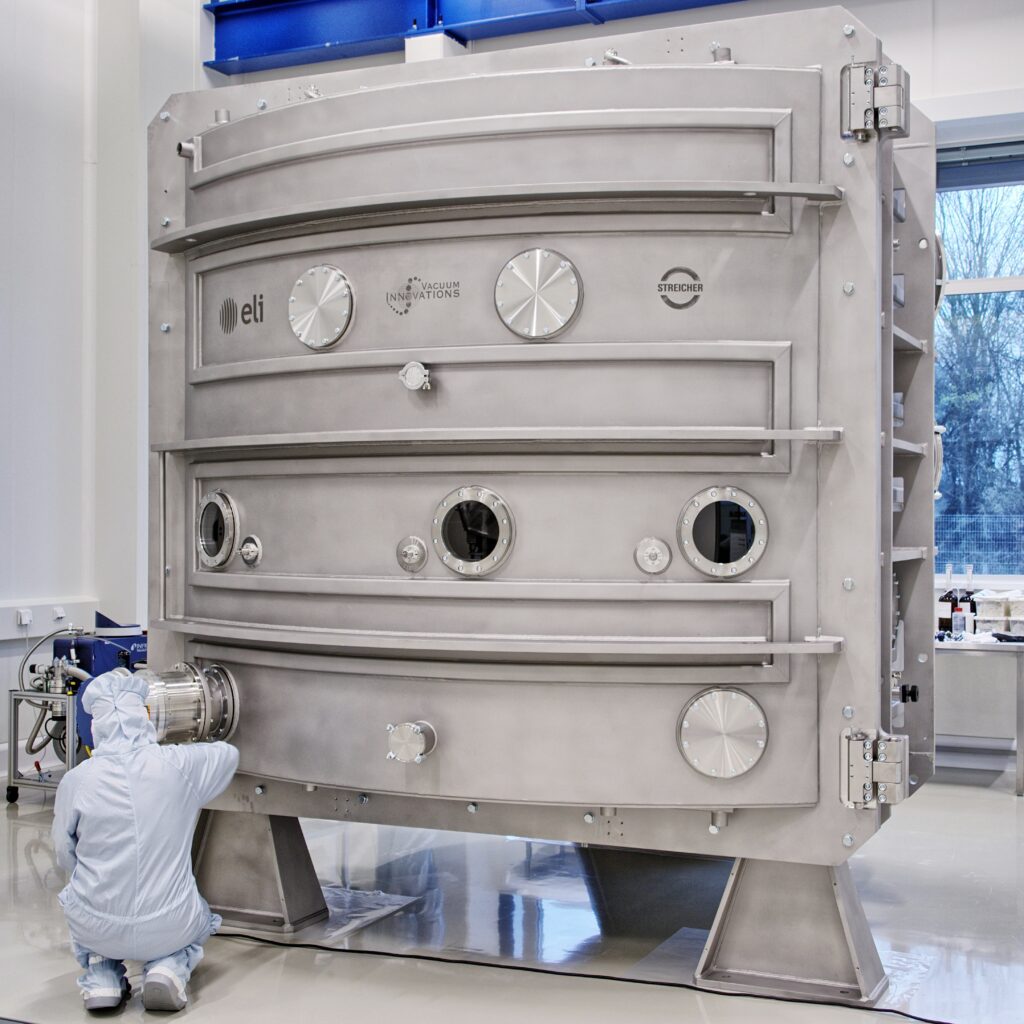
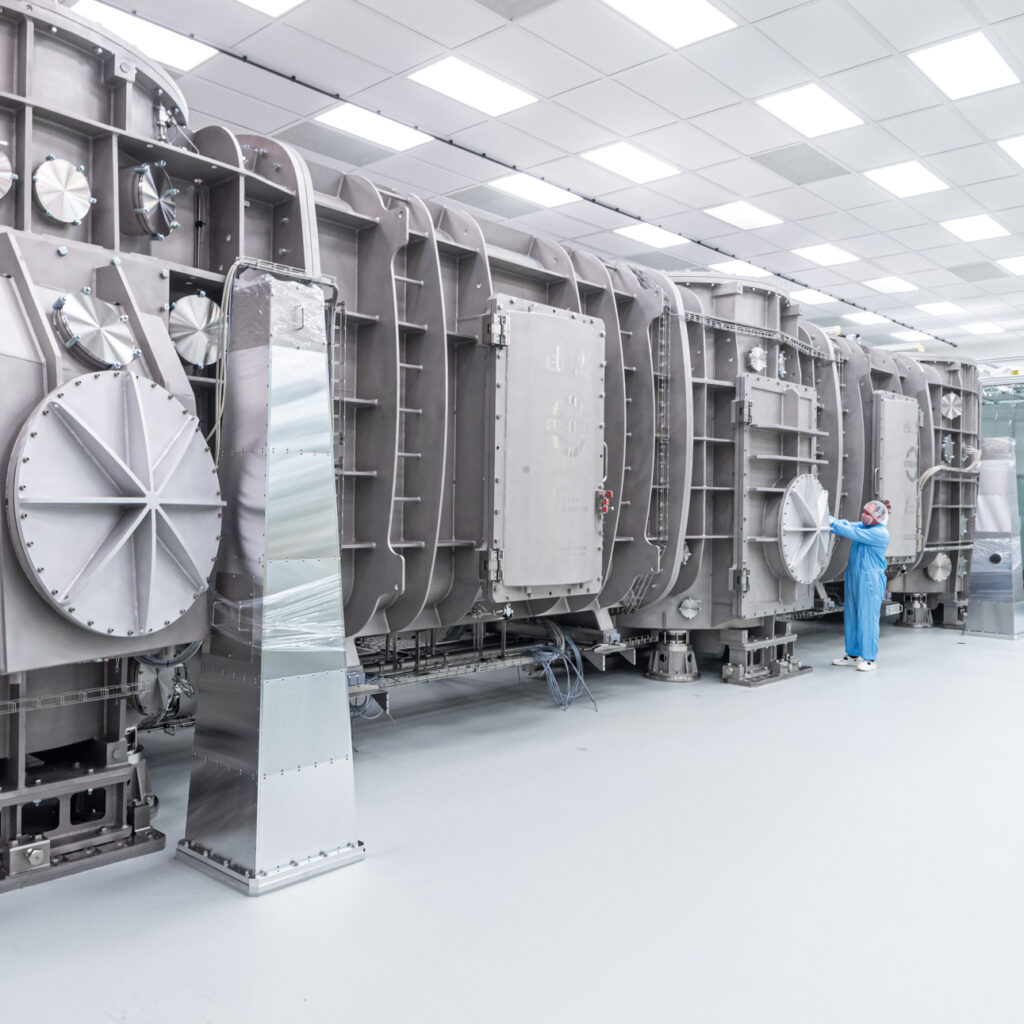
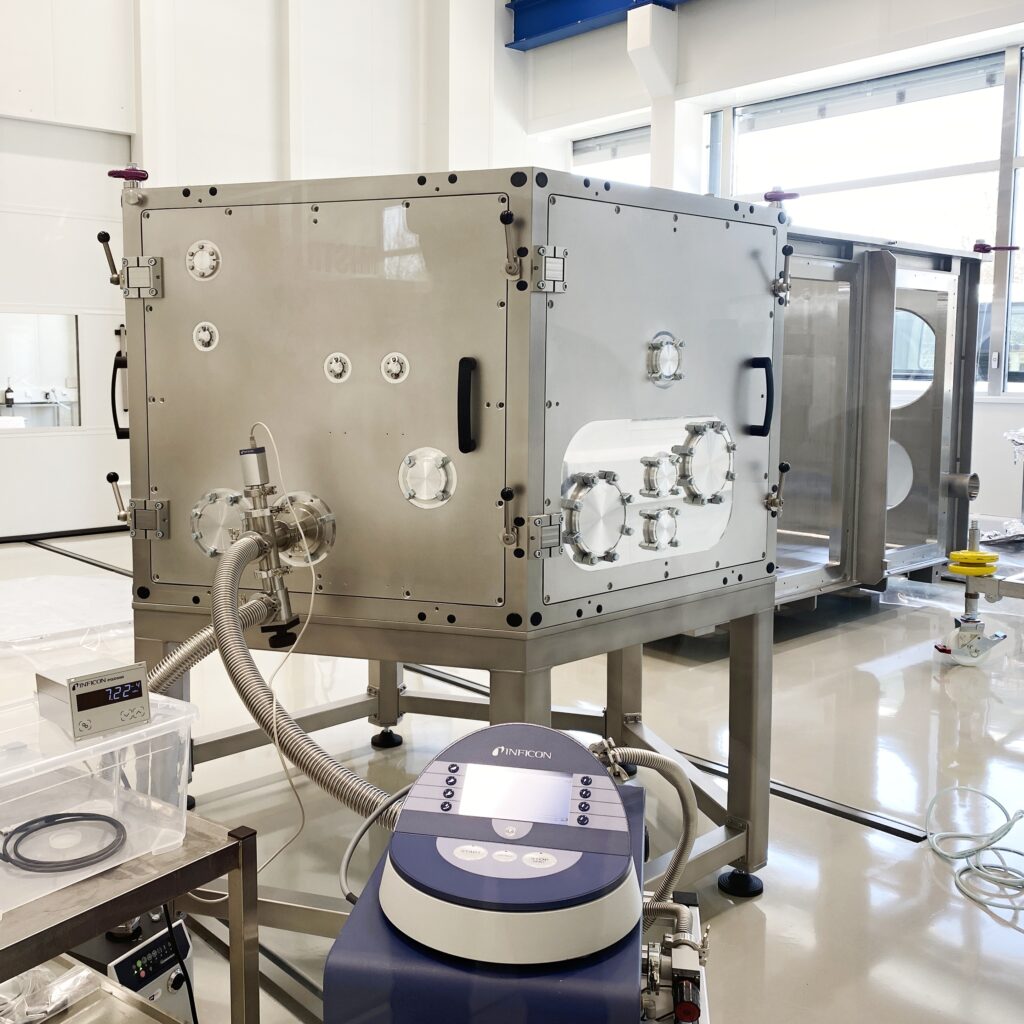
He-leak testing
He-leak testing offers extremely sensitive leak detection, ensuring the system is as tight and safe as possible.
Why do we use he-leak testing?
Leak-tightness
He-leak testing uses helium, a small, neutral atom, to quickly detect tiny leaks. Customers can be confident that their chamber is truly leak-tight and ready for high and ultra-high vacuum applications.
Guarantee of reliability
Due to the test’s extreme sensitivity, it ensures the chamber’s overall performance. This protects equipment from vacuum loss and contamination.
Clearly defined
Each chamber is tested to a specific leak rate limit that matches its vacuum class. You will receive measured data and documentation proving the quality of your vacuum chamber.
Vacuum vs. sniffer method
- In the vacuum method, the tested chamber is evacuated, and helium is applied externally. The detector then captures the gas entering the vacuum.
- This approach is ideal for testing enclosed volumes with high sensitivity because helium can be easily detected under vacuum, even at microscopic leak rates.
- In the sniffer method, the detector is outside the chamber and helium is applied directly to a joint or seal.
- The sniffer method is faster and allows for the precise localization of leaks, but it has lower sensitivity than the vacuum method.
- The vacuum method requires stable low pressure and often a longer evaluation time. The sniffer method, on the other hand, is suitable for quick inspections and maintenance.
- Often, both methods are combined: the vacuum method identifies leaks and the sniffer method localizes them.
Vacuum considerations
- In high vacuum (HV) systems, leaks can be detected using standard helium detectors with a sensitivity of about 10⁻¹² to 10⁻¹⁰ mbar·L/s.
- In ultra-high vacuum (UHV) systems, however, the situation is more complex. Material outgassing and helium diffusion through seals and metal walls can affect measurement accuracy.
- UHV systems require careful chamber preparation and bake-out, as well as specialized detectors with higher sensitivity and stabilization.
- The detector sensitivity must be sufficient to distinguish real leaks from surface desorption.
- UHV systems require slower helium application and longer observation times to obtain reliable data.
- In HV systems, the process is faster and less sensitive to microleaks or surface effects.
- The choice of method depends on the vacuum level and the desired measurement precision.
Sensitivity and detection limits
- The sensitivity of a helium leak detector determines the smallest leak that can be reliably measured. For UHV systems, this is typically from 10⁻¹² mbar·L/s.
- Detectors have specified ranges beyond which readings become unreliable or saturate.
- Sensitivity is influenced by chamber geometry, helium flow, application distance, and vacuum stability.
- Testing small joints and seals requires detectors with high resolution and a fast response time.
- Detectors can be calibrated using certified leak standards to ensure measurement reproducibility.
- Improper sensitivity settings can lead to false positives or negatives.
- In combined methods (vacuum + sniffer), the sensitivities of the detectors complement each other, enabling rapid localization and precise leak quantification.